Mnemonic Devices for Network Engineers
Some acronyms are used so frequently they become part of your lexicon, such as STP, DNS, DHCP. But what about things you need to remember for a cert, or things you have trouble remembering because they're so infrequently used?
5/28/20253 min read
802.1 Standards
Rote memorization may work for some, but it has yet to work for me. Here are some ways I've learned to remember the 802.1 standards I've learned and worked with. Please note, this is the most simplistic, general explanation of the 802.1 standards in this list, and for more please consult the IEEE website [here].
802.1X
How I remember:
802.1X cross-references devices
802.1X is a standard that defines port-based network access controls, outlining authentication before a device can access the network. It cross-access based on the user identity or device authentication
802.1Q
How I remember:
802.1Q is for Queues
802.1Q (dot1q) is a standard that specifically defines VLAN tagging. It allows multiple logical networks to exist, and allows for network segmentation and traffic isolation. It is also used to define how traffic is prioritized and queued across the network, supporting another Q word: Quality of Service (QoS)
802.1D
How I remember:
Draw Bridges (or, Dumb STP)
This one is tricky because technically, 802.1D, S, and W all deal with Spanning Tree. It's the first standard to define STP, and is used mainly in bridged Ethernet networks. It mostly dealt with bridging. I say dealt, because many aspects of 802.1D were incorporated into other 802.1 standards.
802.1S
How I remember:
STP and Switches
This is pretty straight-forward, I remember STP. Specifically, 802.1S defines Multiple Spanning Tree Protocol (MSTP), such as multiple spanning trees for individual VLANs or groups of VLANs. It incorporates all its STP information in a single BPTDU format, and is backwards compatible with RSTP.
802.1W
How I remember:
Can't stop, Won't stop STP
That's right, it's Rapid Spanning Tree (RSTP). 802.1W defines RSTP. It is also backwards compatible with 802.1D, our Dumb STP. It outlines standards for convergence after topology change, bridge port roles to accomplish the convergence, and does it in 3x hello times, providing updates to the topology within milliseconds of a link failure. It cant be stopped, it won't be stopped.
That's all I've come up with for now. Check back, and I'm sure I'll add more-- there's so many things to remember!
It should be obvious at this point I love silly, fun ways to remember concepts. This isn't limited to stories, but includes ways to remember specific things such as standards and acronyms. Some acronyms are used so frequently they become part of your lexicon, such as STP, DNS, DHCP. But what about things you need to remember for a cert, or things you have trouble remembering because they're so infrequently used?
I, personally, have my own mnemonic devices. If you're studying for an entry level cert, please feel free to use these if they're helpful!
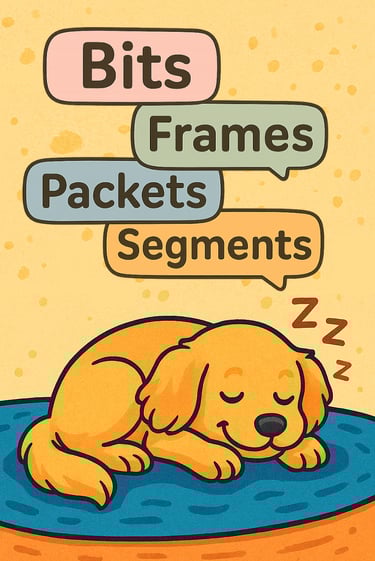
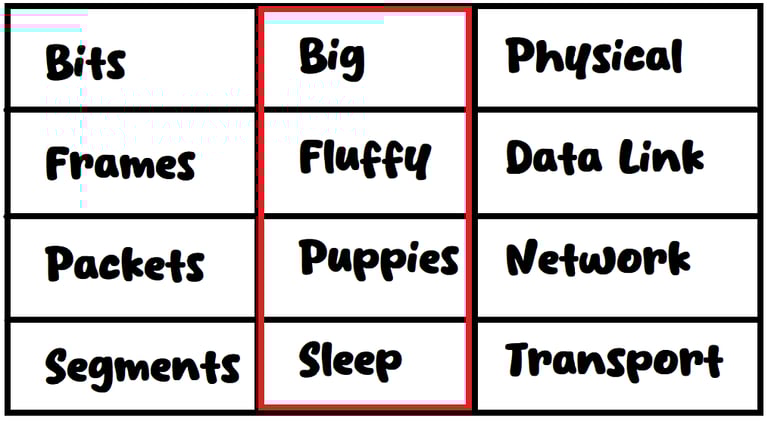
Big Fluffy Puppies Sleep
Who are the puppies? Why are they sleeping? WHERE are the puppies?! Valid questions.
While there are no actual puppies for this one, this is how I've been able to remember Bits - Frames - Packets - Segments.
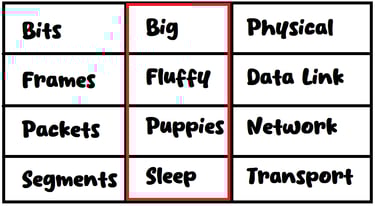
At this point there are several known ways to remember the OSI layers, but I've yet to see anything to help remember this one. As such, I'm very proud of this one. The diagram below may help as well.
Just a reminder: Bits are used in the Physical Layer, Frames in the Data layer, Packets in the Network Layer and Segments in the Transport Layer of the TCP/IP Stack


Demons In Texas Eat Eels Like Fries
I saw this ion youtube in the Jeremy's IT Lab CCNA (Day 27) in the comment section.
As a review, the OSPF neighbor states are: Down > Init > Two-Way > Exstart > Exchange > Full
To review this, I definitely suggest the JIT videos, but here is Cisco's documentation