No teachers, No classroom, Just you
Or, how to study as an adult
6/4/20257 min read
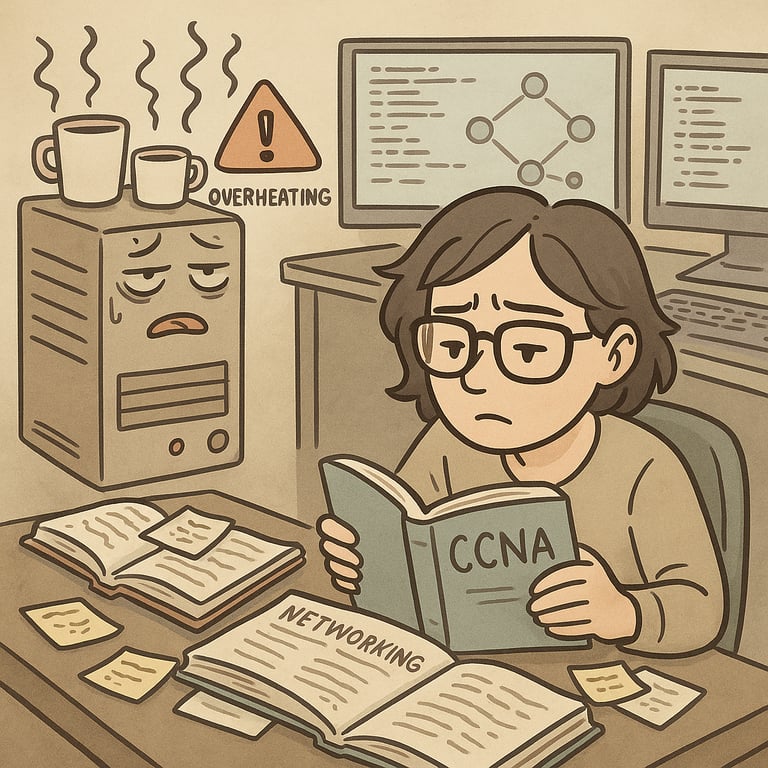
I no longer have a professor giving me assignments, I have no peers to study along with. I have a full time job, personal obligations, and only myself to keep me on track.
What I’ve learned is this: studying itself is a skill. Like any skill, it takes intention, time, and practice to improve. If you resonate with this, keep reading. Hopefully, this can help you beyond your certifications and we can re-learn how to study together.
I think that we have all heard the basics: block off time to study, limit distractions, focus on one thing at a time, use flashcards. These are all wonderful, but they don't really teach how to think about a topic or approach it. If you're studying networking, you're not just learning the material to pass a test, you are ideally learning a functional skill. It's important to really understand a topic, not just pass the test.
Here are some approaches to studying I have found helpful:
I. Approach Labs like a scientist
In case you have forgotten the scientific method, let's review: Question, Research, Hypothesis, Experiment, Data Analysis, Conclusion, and Communication
I'll start with the most obvious method: labs. Love them or hate them, they're a necessary part of developing your understanding of new technology and systems. You are able to learn without completely bricking a production network. As you do labs, I suggest you do the following:
Take meticulous notes on each task you did. Are you entering into Global Configuration mode, or are commands done in Privileged Exec mode? While you take notes, think about how you would leave notes for someone coming in after you. How would you explain the task to them, and not just notes that make sense for yourself in the moment.
Things will go wrong, in your notes describe what went wrong. Were ports Error Disabled? Did you lose access to your DHCP server (guilty), can you not ping a host you expected to be able to ping? Write the results down
This is my most important suggestion: Write how you fixed the error (if possible). Most errors are fixable. I suggest writing down your troubleshooting steps, and the steps you took to resolve the error.
Ultimately, it's important to document your failures as much as your wins (if not more so). You can even find labs that have a troubleshooting focus, where the goal is to fix the problem in the lab (not be the problem on a production network).
Where to find labs:
After you have completed your labs, I do suggest you do a formal write-up. Include a "lessons learned" section at the end to really summarize everything, and to give yourself perspective on how much you have learned.
II. Learn to think algorithmically
This is not a natural mode of thought for many people, at least it wasn't for me. While learning Python, I really struggled to understand basic if/else and for functions. I didn't realize the thing I was missing was thinking like an algorithm. It wasn't until I finally took a course on algorithmic thinking that it clicked, and it has helped tremendously in my studies.
But what do I mean by "thinking algorithmically?" I do not mean use actual algorithms to study, though that might be helpful for some. I mean using the processes that make up algorithms to study:
Group things into manageable, solvable sub-problems
Identify decision making such as cause and effect (If this happens, then this happens)
Determine how this type of problem is usually solved — is it rule-based, layered, or scenario-driven?
Find ways to automate the principles so they can be repeated
Let's start with a non-networking example. We'll use an example from the course I took for this:
Describe, in exact detail, how to make a sandwich in your home to someone who has never, ever made a sandwich or been in your home. They can only follow the directions you give them.
Could you complete this exercise? At first it seems easy, but drilling down it's surprisingly difficult. Did you describe turn for turn how to locate the ingredients and utensils? Did you explain you have to place two slices of bread side by side? How to extract condiments from their jars and get it on the bread?
How to think algorithmically: We can break down each aspect of the sandwich into smaller problems, and chain the problems together. We can add in some True/False logic: has the bread been acquired? If yes, proceed. If no, acquire bread following these steps. We can even troubleshoot: If there's no strawberry jam, choose raspberry. This system we created is repeatable for other sandwiches, parts of it can even be used in other meals.
But how does this apply to learning?
If we take a complicated topic, break it down into small parts that have a structured system, and chain them together we will build bigger, broader picture of a topic. Using networking as an example, we can build out ideas and concepts for different protocols and concepts. So when it comes time to take a test, or build a network, if we forget the next step we have a reliable, repeatable thought process to get us to the right conclusion.
Here's some steps to thinking algorithmically:
Pick a topic
Identify inputs, goals, and larger systems
Identify conditions: what decisions must be made and when, is there a Yes/No or True/False logic behind these conditions, what happens next?
Draft your algorithm: Use if/then statements at start and expand out as you develop your system.
Write it down! Visualize your algorithm. It can be a flow chart, a decision tree, whatever works best for you.
Consider including and mapping possible points of failure and how to troubleshoot.
III. Use the Feynman Technique
The Feynman technique is simple:
Study
Teach
Identify gaps
Simplify
It is also commonly referenced as teaching a complete novice what you know. Whether that be a child, your partner, a dog, or even an inanimate object, explaining out loud the topic at hand is a great way to get a picture of your understanding of a topic. If you can use simplistic language to explain the topic even better-- we really know a subject when we can use very simple language to complex ideas.
If you have a language-capable student (ie: not a pet or stuffed animal), having them ask you questions is a great way to get quizzed on a subject and expand on your explanations.
IV. Go in reverse order
When you lose something, you go to the place you last saw the thing and work your way backwards. This same process is a great study technique because it allows us to conceptualize the end goal of a topic, and reverse engineer the processes.
Here's an example of how I use this while studying for my CCNA:
Write out on a piece of paper a network topology
Create a list of configurations for each device and how you would like them to connect with each other
On the same piece of paper work out in reverse order the processes you'd need to get there, from network to cable
I prefer paper because at the end of this exercise I can go again in reverse order, using it as a checklist.
I have really come to rely on this technique, because as an end user you may not consider everything that goes to serving you up your shared resources and connecting you to the Internet. If you're just studying for your certs with little networking background, it's possible you've never even considered things like mail servers or VLANs. As a bonus, this technique can really prepare you to talk to end users in the future while trying to troubleshoot their issues, or explain new updates to the system.
V. Review what you learn
Review is critical for making sure we understand topics, for refreshing our brains with material we have previously learned, and for cementing that information. There are tons of review techniques, but I have some tips of my own:
Take hand written notes while studying or going through the material
After each study session, review the hand written notes
The next day, type up the notes in a word processor or hand-write them in a more organized format
Review the material from days before in the formalized format and add/notate as needed. I aim for a three day delay for each section I study.
I also suggest brain purging before you study, and especially before you review. What does that entail? Essentially, I will empty my brain onto a sheet of paper so that it's a fresh canvas for what I am studying. Writing all your thoughts, sundry to-do lists, thing you might want to look up down on a blank piece of paper. It's important to not look things up, just write them down.
VI. Take breaks, and know when to move on
This isn't new information, but it always seems to pop up when I see people struggling with studying. People get so focused they put off self care, or they beat themselves up because they don't have mastery of a subject and feel like they can't move on until you do.
Sometimes, it's best to just move on. Somewhere down the road, the thing you're struggling with may click in your brain. You can always come back to the topic later. Take a break, get a snack, and if necessary move on and come back with fresh eyes another time.
When studying for certs we can put so much stress on ourselves, it's important to remember the information isn't going anywhere. It's very difficult to learn and study under stress, especially if you're an already stressed-out adult with responsibilities. But if we take our time we can master the subject we're trying to learn.
Are you experiencing the same roadblocks over and over? Do you struggle to retain information you just learned? Has it been years (or decades) since you last sat in a classroom?
I'm well into my adult years. Since deciding to dive head-first into networking and cybersecurity, I have noticed that I have one issue hovering over me:
I've totally forgotten how to study.