STP Pt 2
Why bother learning STP in 2026?
2/22/20263 min read
Welcome back to part 2!
When we last met, we explained that STP (Spanning Tree Protocol) is a lot like rerouting your drive home when there's a jam. It keeps things moving. It'd be bad if your network crashed because of a broadcast storm! Modern networks look different than a basic STP design. They are built on multiple layers for enhanced redundancy, aggressively segment traffic, and can be deployed remotely. If you're studying for your CCNA or other introductory networking certification you'll notice STP occupies a decent amount of the objectives. You may be tempted to skip it, thinking that everything is modernized now.
But... What if I told you STP still holds relevance today?
In this post, we'll focus on two environments STP remains critical to operations: CNC controllers and SCADA systems. These aren't just edge cases. STP plays a major role in their operations, earning its continued relevance in our learning material.
First, let's address what these new terms mean.
CNC Controllers
Computer Numerical Control (CNC) machines are automated tools that are run by a computer, a controller. CNC machines are motorized, maneuverable tools that execute actions based on specific input instructions. CNC controllers turn 3D CAD (Computer Aided Drawings) drawings into physical items. CAD drawings are translated using CAM (Computer Aided Manufacturing) to generate code (G-code) instructions for the controllers in the CNC machine to precisely produce components out of materials such as wood, plastic, and metal. CNC controllers translate digital instructions into the machining process. It's easy to see how these controllers are the backbone of manufacturing and production systems worldwide. A software or networking error could potentially halt production!
SCADA systems
Supervisory Control and Data Acquisition (SCADA) systems are used across multiple industries, including manufacturing and power distribution (two very important things). SCADA devices are specialized for each job they perform. On the manufacturing floor, SCADA systems can provide real-time control and visibility, detect faults in the manufacturing process, initiate safety protocols (such as restoring power), and issue control commands across a facility. In these environments, unexpected network patterns can directly affect performance and output!
How do these systems rely on STP?
Many of these machines were placed on the network before modern networking protocols were implemented. Using an abundance of precaution, many engineers have opted to leave these systems in place rather than risk a disruption.
A disruption in a factory could cost the company millions of dollars and a production backlog. It's not worth it to risk a stoppage just to modernize the network. In some cases, changing the topology might void machine warranties. In some cases regulatory approval may be needed before any changes are made due to the critical nature of some applications.
Much of the time, they're isolated on the network in their own VLANs or physical segments, thus limiting their exposure while still relying on Layer 2 protocols for stability. STP can act as a safeguard, ensuring the network remains predictable and that everything continues to operate safely and securely.
How a "normal" change in the environment can cause disruption:
- routine maintenance window
- engineer adds a redundant link, replacing a switch, and restoring connectivity
- normally, this would make sense. But this is a manufacturing facility!
- CNC machines stop mid-operation
- HMIs freeze without error
- SCADA alerts to something going terribly wrong, but there's no obvious cause from the operators on the floor
- no "network down" alerts or obvious failure points
- The controllers assumed the network is static, and a L2 loop caused a critical failure. The network is technically "up," but the machines aren't working
- STP would have blocked the unsafe path, and the change would have been a non-event according to the network. Traffic would have been forwarded along the newly rerouted path and production would have continued.
- Solution: a quick-thinking engineer reviews the changelog (a CCNA objective) and sees that a switch was replaced overnight. They are able to restore operations, and implement STP to prevent another outage
Suggested reading:
CNC:
https://ipcisco.com/lesson/stp-operation/
https://www.ti.com/lit/wp/spry316c/spry316c.pdf?ts=1771109873461
SCADA:
https://ieeexplore.ieee.org/document/5442806
https://scadaprotocols.com/rstp-industrial-ethernet-networks/
Stay tuned for a story about a quick-thinking engineer using her knowledge of STP to save the day!
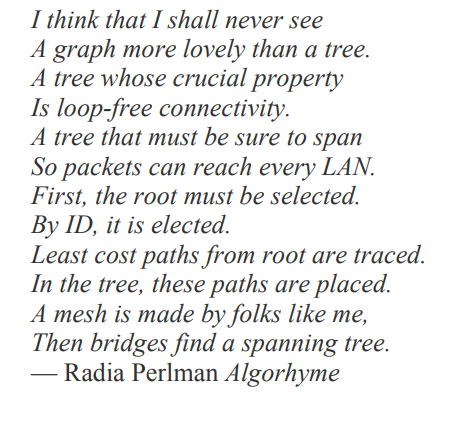
To learn more about Radia Perlman, inventor of STP, please see here